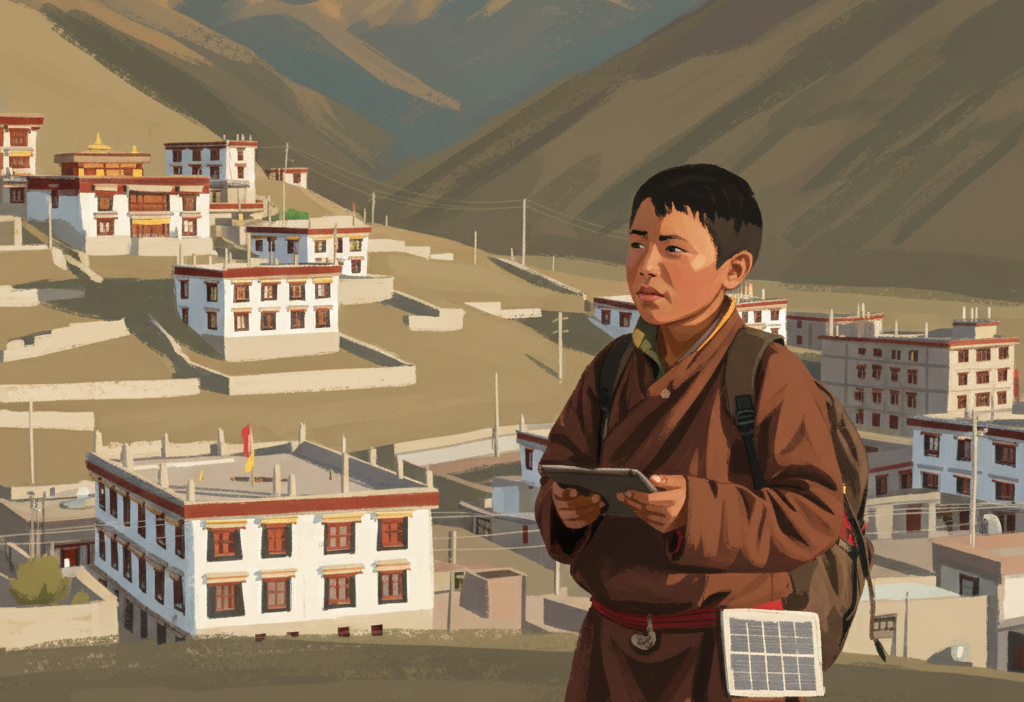
The Bardo of the Future
མ་འོངས་པའི་བར་དོ།
We Are Living in a Bardo
In Tibetan wisdom, a Bardo (བར་དོ) is not only the state between death and rebirth.
A Bardo is any moment when the old world has ended, but the new world has not yet fully formed.
Today, humanity is living in such a moment.
Our children are being born into:
- A world where technology evolves faster than ethics
- A world where identity is shaped by algorithms
- A world where traditional education is uncertain
- A world where attention is constantly pulled outward
This is not a normal historical period.
It is a transitional age.
Understanding this clearly is the first responsibility of a parent.
Why This Era Feels Unstable
Parents often feel:
- Anxiety without a clear reason
- Fear about their children’s future
- Pressure to “keep up”
- Confusion about education and careers
These feelings are not personal failure.
They arise because:
- Old systems are dissolving
- New systems are untested
- Certainty is no longer guaranteed
In Tibetan understanding, confusion is a natural symptom of a Bardo.
The danger is not confusion itself.
The danger is reacting to confusion with fear.
Children Feel What Parents Do Not Say
Children are extremely sensitive.
Even when parents:
- Do not speak about fear
- Try to appear confident
- Avoid difficult topics
Children still feel:
- Emotional tension
- Uncertainty
- Instability
If parents are anxious, children absorb anxiety.
If parents are calm, children feel safe — even in uncertainty.
This is why parental understanding comes before child instruction.
The Difference Between Fear and Clarity
Fear says:
- “The future is dangerous”
- “Technology will destroy values”
- “Our culture is disappearing”
- “My child will not survive”
Clarity says:
- “Change is happening”
- “Every era has challenges”
- “Human wisdom is still needed”
- “My child needs grounding, not panic”
This module is about moving from fear to clarity.
Clarity does not deny risk.
It removes paralysis.
Why We Call This the “Bardo of the Future”
In traditional teachings, the Bardo is:
- Unstable
- Full of unfamiliar appearances
- Confusing but full of opportunity
The same is true today.
Technology, AI, and digital life are:
- Neither good nor bad by nature
- Powerful amplifiers of intention
- Dangerous without ethics
- Beneficial with wisdom
Children need guides, not guards.
Parents must learn to navigate the Bardo first, so they can guide others.
The Parent’s True Role in a Transitional Age
Parents are not meant to:
- Predict the future
- Control outcomes
- Force certainty
Parents are meant to:
- Create emotional safety
- Provide cultural grounding
- Model calm relationship with change
- Teach discernment
In Tibetan terms, parents become lamas of daily life — guiding not through authority, but through presence.
Stability Does Not Come From Systems
In the past, stability came from:
- Predictable careers
- Clear social roles
- Fixed traditions
Today, these are shifting.
So stability must come from:
- Inner values
- Emotional regulation
- Identity rooted in meaning
- Capacity to adapt
This is why culture, Dharma, and emotional intelligence matter more than ever.
What Happens If Parents Do Not Understand This Bardo
Without understanding, parents may:
- Overcontrol children
- Panic about education
- Demonize technology
- Transmit fear unconsciously
This creates:
- Anxious children
- Rebellious reactions
- Identity confusion
- Burnout at a young age
Fear narrows possibility.
What Happens When Parents Understand the Bardo
When parents understand the nature of this age:
- Fear softens
- Patience increases
- Perspective widens
Children experience:
- Emotional safety
- Trust in guidance
- Confidence in uncertainty
- Openness to learning
This is the foundation of future readiness.
A Simple Practice for Parents (Module 1)
Daily Grounding Reflection
Once a day, silently remind yourself:
“This is a time of transition.
I do not need all answers today.
My calm is my child’s safety.”
This single reflection reduces unconscious fear transmission.
Questions for Parental Reflection
You may reflect quietly or journal:
- Where do I feel fear about my child’s future?
- Is this fear coming from facts, or from uncertainty?
- How do I react to change — with resistance or curiosity?
- What qualities do I truly want my child to embody as a human being?
There are no right answers.
Only awareness.
What This Module Prepares You For
By completing this module, parents are ready to:
- Build identity without rigidity
- Introduce culture without pressure
- Teach emotional intelligence calmly
- Engage with technology wisely
This module is the ground beneath all others.
Core Teaching to Carry Forward
This age is not asking parents to be perfect.
It is asking parents to be awake.
Closing Blessing for Module 1
May confusion turn into clarity.
May fear soften into wisdom.
May parents stand steady
in times of change.
May children walk forward
without losing their humanity.བཀྲ་ཤིས། བདེ་ལེགས།
👉 Continue to Module 2
Roots Before Wings — Tibetan Identity at Home