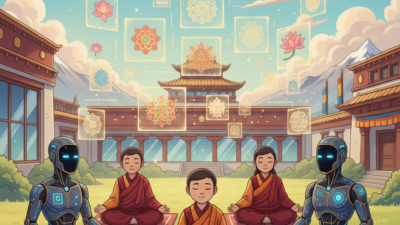

Wisdom Before Information
ཤེས་རབ་སྔོན་ལམ། གནས་ཚུལ་ལས་སློབ་པ།
We Are Drowning in Information, Not Wisdom
Previous generations struggled to access information.
This generation is overwhelmed by it.
Children today live with:
- Instant answers
- Endless content
- Constant notifications
- Shallow engagement
But information is not learning.
Learning requires:
- Attention
- Curiosity
- Reflection
- Integration
This module helps parents understand how learning truly happens, so children can adapt to any future.
Why “Learning How to Learn” Matters More Than Any Subject
Subjects change.
Careers change.
Technologies change.
The ability to learn never becomes obsolete.
Children who know how to learn:
- Adapt to new fields
- Recover from failure
- Teach themselves
- Stay curious
Children who only memorize:
- Depend on systems
- Fear change
- Collapse under uncertainty
This module shifts focus from performance to process.
The Difference Between Knowledge and Wisdom
Knowledge is:
- External
- Accumulated
- Replaceable
Wisdom is:
- Internal
- Integrated
- Irreplaceable
In Tibetan understanding, wisdom arises when:
- Knowledge is reflected upon
- Experience is digested
- Understanding shapes behavior
Parents must guide children beyond “what to know” into “how to understand.”
Curiosity Is the Engine of Learning
True learning begins with curiosity, not pressure.
When children ask questions:
- They are engaging deeply
- Their minds are open
- Learning becomes joyful
Pressure kills curiosity.
This module teaches parents how to:
- Welcome questions
- Allow exploration
- Reduce fear of mistakes
- Praise effort, not outcome
Curiosity creates lifelong learners.
Attention Is the Gatekeeper of Learning
Without attention, learning does not occur.
Modern distractions fragment attention:
- Rapid content switching
- Multitasking
- Screen dependency
This weakens:
- Memory
- Comprehension
- Patience
Parents must protect attention as a precious resource.
Teaching Focus Without Force
Focus cannot be demanded.
It must be trained gently.
Parents can:
- Limit unnecessary stimulation
- Create quiet learning spaces
- Encourage single-task activities
- Model focused behavior
This module introduces focus as a skill, not a personality trait.
Mistakes Are a Core Part of Learning
Children often fear mistakes because:
- They are corrected harshly
- Compared with others
- Praised only for success
Dharma teaches learning through:
- Trial
- Observation
- Adjustment
Parents must reframe mistakes as:
“Information about what works.”
This builds resilience.
Learning Is Embodied, Not Only Mental
Children learn best when:
- Hands are involved
- Senses are engaged
- Body participates
Activities like:
- Writing
- Drawing
- Building
- Practicing art
Deepen learning far beyond screens.
This prepares children for creative and adaptive thinking.
Digital Learning Needs Discernment
Technology can support learning when used wisely.
Parents should teach children:
- Not everything online is valuable
- Depth matters more than speed
- Algorithms shape attention
Learning discernment protects against:
- Misinformation
- Superficial knowledge
- Cognitive overload
This is part of wisdom training.
The Parent’s Role: Guide, Not Controller
Parents are not meant to:
- Control every learning outcome
- Decide every interest
- Compare constantly
Parents are meant to:
- Encourage exploration
- Offer structure
- Protect focus
- Model learning curiosity
Children learn from how parents learn.
What Happens When Learning Is Misunderstood
Without guidance, children may:
- Chase grades without understanding
- Lose curiosity
- Burn out early
- Depend on external validation
This creates fragile learners.
What Happens When Learning Is Understood
Children who know how to learn:
- Enjoy discovery
- Adapt quickly
- Think independently
- Retain knowledge deeply
This is true intelligence.
A Simple Practice for Parents (Module 4)
Daily Learning Reflection
Ask once a day:
- “What did you learn today?”
- “What surprised you?”
Avoid:
- Grades
- Scores
- Comparison
This shifts focus to growth.
Questions for Parental Reflection
- Do I value effort or results more?
- How do I react to mistakes?
- Do I model curiosity?
- How do I use technology myself?
Children learn silently from observation.
What This Module Prepares You For
By understanding learning itself, parents are ready to:
- Introduce AI wisely (Module 5)
- Teach focus through meditation (Module 7)
- Support creative disciplines (Module 6)
- Encourage future adaptability
Learning how to learn is the spine of future readiness.
Core Teaching to Carry Forward
Intelligence is not how much you know.
It is how deeply you understand
and how freely you can learn.
Closing Blessing for Module 4
May curiosity remain alive.
May attention stay protected.
May wisdom grow from experience.
May children learn without fear.བཀྲ་ཤིས། བདེ་ལེགས།
👉 Continue to Module 5
Preparing Children for AI Without Fear