
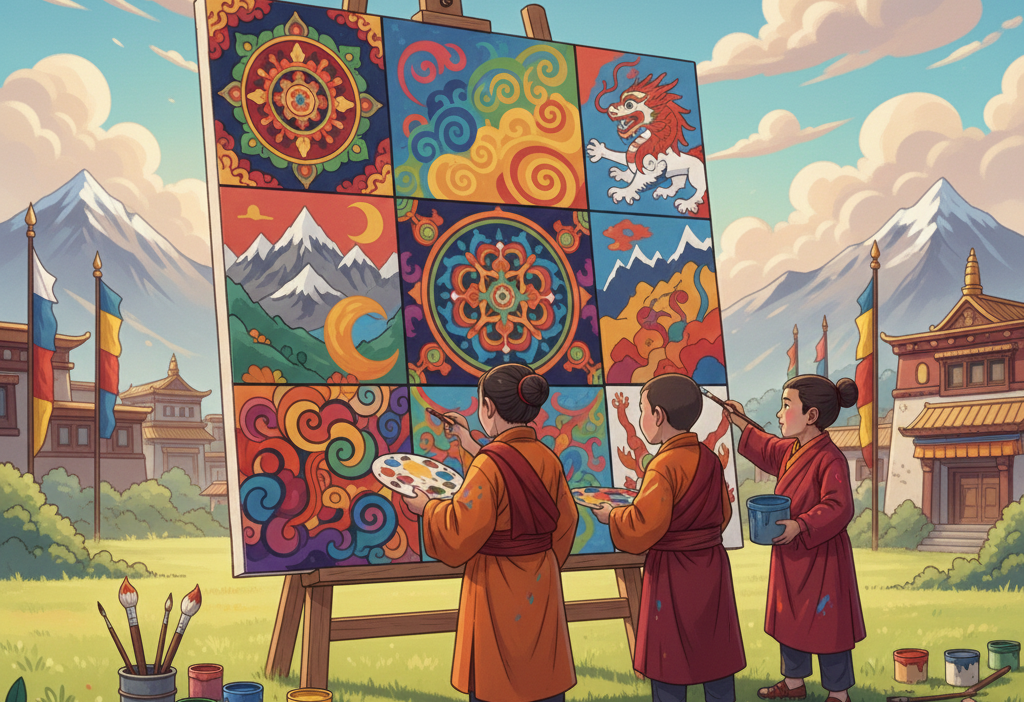
Training the Mind Through Sacred Form
རིས་སྐུ་ནི་སེམས་ཀྱི་སྦྱོང་བ།
Art Is Not Decoration — It Is Training
In Tibetan tradition, art is not aesthetic entertainment.
It is a discipline of mind, perception, and ethics.
Every line, proportion, and color is a cognitive exercise.
This makes Tibetan art uniquely relevant for children growing up in an AI-driven world.
Why the Future Demands Deep Attention
Modern technology:
- Shortens attention span
- Encourages fast consumption
- Reduces patience for complexity
Yet the future requires:
- Focus
- Pattern recognition
- Long-term thinking
- Visual intelligence
Tibetan art trains exactly these faculties.
The Brain Learns Through the Hands
Neuroscience confirms what Tibetan masters always knew:
- Hand movement shapes brain development
- Repetition stabilizes focus
- Fine motor skills support cognition
Drawing, painting, and mandala work develop:
- Neural integration
- Emotional regulation
- Spatial intelligence
Thangka Painting as Mental Architecture
Traditional thangka painting trains:
- Proportion awareness
- Sequential thinking
- Memory
- Ethical patience
Nothing is rushed.
Children learn:
“The mind must be steady before the hand moves.”
Sacred Geometry and Cognitive Mapping
Tibetan art uses:
- Mandalas
- Symmetry
- Directional symbolism
This strengthens:
- Spatial reasoning
- Mathematical intuition
- Systems thinking
These are the same skills needed in:
- Engineering
- Design
- AI system logic
Color as Emotional Intelligence Training
Colors are not chosen randomly.
Each color:
- Represents elements
- Regulates emotion
- Teaches balance
Children unconsciously learn:
- Emotional awareness
- Energy modulation
- Inner stability
Art as Emotional Regulation
Children often struggle to express emotions verbally.
Art provides:
- Safe emotional release
- Non-verbal expression
- Inner ordering
This prevents:
- Emotional suppression
- Anxiety buildup
- Digital dependency
Creating Versus Consuming
Modern children consume images endlessly.
Tibetan art teaches:
- Creation over consumption
- Presence over stimulation
- Depth over novelty
This reverses modern cognitive imbalance.
Ritual Precision Builds Executive Function
Following artistic rules:
- Measurements
- Sequences
- Ethical preparation
Strengthens:
- Discipline
- Planning
- Self-regulation
These are core executive skills.
Art as a Mirror of Mind
In Tibetan tradition:
The artwork reflects the state of the mind.
Children learn:
- Responsibility for quality
- Awareness of distraction
- Humility in learning
This builds self-awareness without shame.
Why Digital Art Alone Is Not Enough
Digital tools are useful but incomplete.
Physical art:
- Engages the body
- Grounds attention
- Develops patience
Parents should balance both.
Integrating Art Into Daily Family Life
Practical ways:
- Weekly art hour
- Mandala coloring
- Freehand drawing
- Clay modeling
No pressure for perfection.
Art as Cultural Continuity
Tibetan art carries:
- History
- Philosophy
- Ethical values
Children inherit identity without lectures.
Preventing AI-Age Cognitive Weakness
Art counters:
- Shallow thinking
- Instant gratification
- Emotional numbness
This protects mental health.
The Parent’s Role in Artistic Training
Parents should:
- Participate, not supervise
- Value process, not outcome
- Avoid comparison
Presence matters more than skill.
A Simple Practice for Module 6
Sacred Drawing Time
Once a week:
- Sit quietly
- Draw one symbol
- Observe breathing
This trains mindfulness naturally.
Questions for Parental Reflection
- Do I value speed or depth?
- How do I respond to mistakes?
- Am I present during creative time?
Children feel these answers.
Preparing for the Next Modules
This module prepares children for:
- Meditation training (Module 7)
- Future vocation clarity (Module 8)
A focused mind is the foundation.
Core Teaching to Carry Forward
When the hand is steady,
the mind becomes steady.
Closing Blessing for Module 6
May the child’s hands be skillful.
May the mind be clear.
May art become a path of wisdom.བཀྲ་ཤིས། བདེ་ལེགས།
👉 Continue to Module 7
Meditation: The Ultimate Attention Training